


Originally published on 16th September 2017, and updated on 15th June 2025
Anything follows from a contradiction.
A moon made of cheese. Triangles with five sides. Cats with ten legs. Time flowing backward.
This bizarre fact stems from a fundamental principle in formal logic known as the Principle of Explosion, also called Ex Contradictione Quodlibet or Ex Falso Quodlibet. It’s foundational to classical logic (and other systems of logic), and vital for understanding how we argue, debate, and reason.
I love formal logic (yes, I know — don’t worry — I have some other marginally less dry interests too..!) and Ex Contradictione Quodlibet is my favourite proof.
What this proof shows us is that in classical logic, accepting a contradiction allows any statement to follow.
So – how does the Principle of Explosion work?
Proving the Principle of Explosion
The Principle of Explosion starts with a simple but startling premise:
Any statement, no matter how absurd, follows from a contradiction.
Okay, so the moon won’t suddenly transform into cheese if you colloquially contradict yourself. But if you could somehow make that contradiction logically true, then anything you imagine – however fantastical – would logically follow.
If any statement is both true and not true, then anything we can think of also becomes true. Let’s look under the hood of the proof and walk through its four steps.
1) Assume there’s a contradiction
Let’s start with a contradiction. In order to prove that anything follows from one, we need to assume one in the first place and see what happens!
Premise 1: A is true, and A is not true.
"Grass is green, and grass is not green."
From this assumption, we can derive two sub-premises to use later:
Premise 2: A is true (from Premise 1)
Premise 3: A is not true (from Premise 1)
- "Grass is green"
- "Grass is not green"
2) The "OR" rule in logic
Imagine you tell me, "The grass is green, or I'm a secret agent." Even though the second part is completely unrelated and unlikely (unless you’re hiding something!), the whole sentence is still true because the first part – "The grass is green" – is true. We're introducing an "or" – in logic we call this a disjunction.
Disjunction introduction: if a proposition A is true, then the disjunction "A or B" is also true.
Only one part of a disjunction needs to be true for the entire statement to hold.
So, from Premise 2 (A is true), we can derive by disjunction introduction:
Premise 4: A is true, or B is true.
Here’s the curious part: B could stand for anything – even the most ridiculous or far-fetched statement. As long as A is true, "A or B" is true.
- "Grass is green, or the Universe is a giant solid gold pyramid."
- "Grass is green, or all triangles have five sides."
- "Grass is green, or 𝐵" – 𝐵 can be any proposition
3) Contradiction forces B to be true
Remember Premise 3? A is not true.
This creates a logical necessity: if A is false, B must be true.
Conclusion: B is true
- "the Universe is a giant solid gold pyramid"
- "All triangles have five sides"
- "B" – B can be any proposition!
This is the Principle of Explosion in action. The presence of a contradiction makes anything and everything true.
...And that's why we ban contradictions
Well, clearly, we don't want any and every propsition to be true! The idea is obviously absurd.
So many types of logic ban contradictions altogether. This rule is known as the Principle of Non-Contradiction, famously championed by Aristotle.
Principle of Non-Contradiction: A statement cannot be both true and false at the same time.
The Principle of Non-Contradiction explains why we can dismantle someone's argument by proving a contradiction in someone’s argument. This is the manoeuvre we call Reductio Ad Absurdum, or ‘reduction to absurdity’.
Here's the proof in formal logic, in case you're interested:

P1:      𝐴 ∧ ¬𝐴 (Assumption)
P2:      𝐴 (from P1, Conjunction elimination)
P3:      ¬𝐴 (from P1, Conjunction elimination)
P4:      𝐴 ∨ 𝐵 (from P2, Disjunction introduction)
P5:      ¬𝐴 → 𝐵 (From P2 and P3, Contrapositive of disjunction)
C:       𝐵 (From P3 and P5, Modus Tollens)

This is the Principle of Explosion:

𝐴 ∧ ¬𝐴 ⊢ 𝐵
Beyond classical logic: paraconsistent logics
One more complication. This proof works in most logics, including classical logic and intuitionistic logic. These logics are said to be explosive because they make the principle of explosion true. But there are other systems of logic, paraconsistent logics, which allow contradiction. They reject the Principle of Non-Contradiction and maintain dialetheism: the idea that some statements can be both true and false.
In paraconsistent logic, contradictions are considered potentially useful and help us reason about things like wave-particle duality and paradoxes.
For example, if you take a quantum particle, it can be in two states at once (seemingly contradictory), but that’s okay within certain logics. Similarly, paradoxes like the Liar Paradox ("This statement is false") can be handled by embracing contradictions in a controlled way.
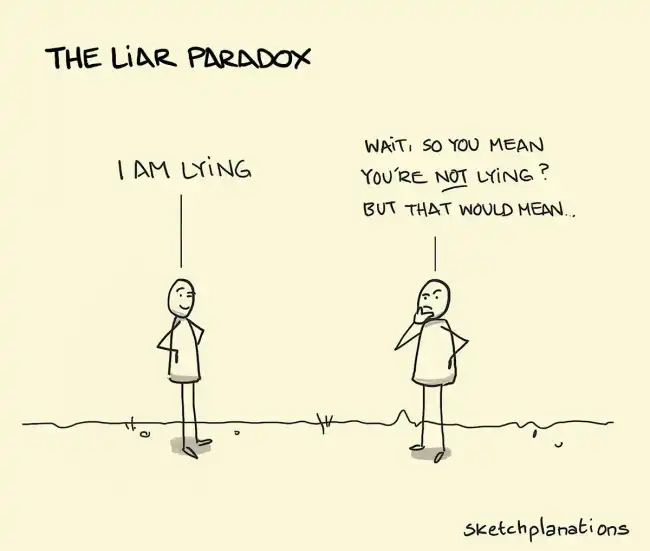
Credit: Jono Hey, Sketchplanations https://sketchplanations.com/the-overview-effect
I wrote in detail about paraconsistent logics here.
A personal note
If you're here, you probably value consistency in reasoning and enjoy the process. Maybe you're even a student of philosophy, as I was! You might also consider applying these skills in unexpected ways.
These skills gave me a strong foundation for learning to code – a skill that transformed my career. If you’re in the UK, I studied at Northcoders. They’re fab.

