


There is, frankly, way too much noise on AEO/GEO for start-ups.
You already know just how focussed start-ups need to be (as if we don't already have enough to think about), but leaders increasingly understand that something needs to happen to get their brand talked about by AI, but not always what, or what expectations they should have.
Does my start-up need to think about AEO and GEO?
In a nutshell...
If you're still establishing a basic pipeline or product-market fit, I probably wouldn't even stick a nose down the AEO/GEO rabbit hole (yet). Optimising for AI answers is almost certainly not your biggest bottleneck.
Use AEO/GEO to scale your position once the fundamentals are in place.
Otherwise...
The commercial point of doing AEO/GEO
The idea behind working on AEO/GEO is that we're trying to...
- Be discovered through AI
- Build trust in a buyer's mind as early as possible.
If our brand keeps appearing everywhere a potential buyer looks, they're substantially more likely to buy – 95% of B2B buyers buy from vendors already on their day-one shortlist.
Most buyers have a preferred vendor in mind before they ever make contact, and 95% of deals are won by vendors that were already on the buyer's initial shortlist.
Long story short, we expect that:
Early exposure => Convert better, close faster, lower acquisition cost, increase MRR.
AEO/GEO can give us more of that early exposure.
What actually are AEO and GEO?
Very simply:
- SEO helps us rank in search engines
- AEO (Answer Engine Optimisation) helps us appear in AI-generated answers.
- GEO (Generative Engine Optimisation) is the broader practice of optimising how AI systems understand, retrieve and recommend our brand.
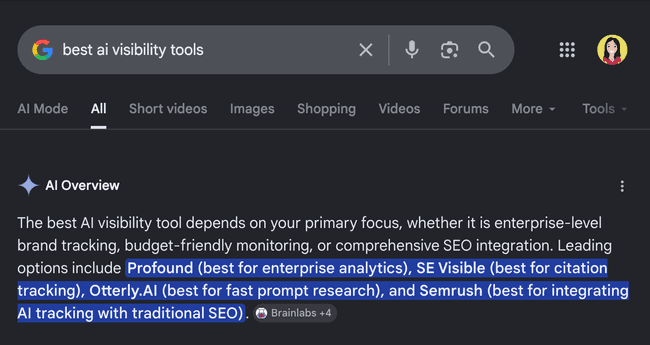
An AI Overview in Google
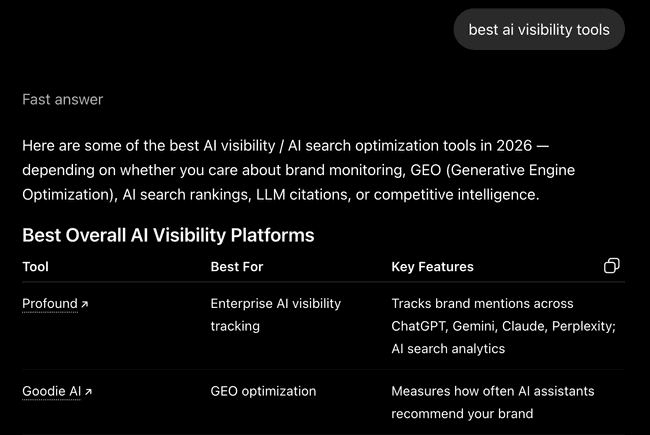
An ChatGPT-generated answer
People are increasingly using AEO and GEO interchangeably.
Instead of just competing to rank on Google, we're now competing to get recommended by ChatGPT, Perplexity, Google AI and so on. Our customers are discovering brands like ours through AI, and the way LLMs decide who to talk about requires us to be proactive in getting LLMs to understand and trust us.
Start-ups are usually small fish in big ponds, and that makes things tricky. AI tends to favour the big fish, because – basically – they trust them.
Yet don't despair! Just because big names take home the biggest slices of cake doesn't mean we can't have some too.
A small slice of a very big cake can still be filling for a small fish.
Excuse the mixing of metaphors. Don't feed cake to fish.
Two big misconceptions
Misconception 1: "AEO/GEO is a separate thing from content strategy"
AEO and GEO require something but an entirely new strategy? Nope. Wrong way to think about it.
Companies already performing in AI search are basically performing because they already have good underlying SEO fundamentals, and by that, I mean they have authority in their niche, useful content that gets eyes on it, and search engines and LLMs understand their category associations.
You can think of it like this: AI visibility tends to amplify strong strategy more than rescue weak strategy.
AI systems still reward the same stuff search engines do: Experience, Expertise, Authoritativeness, Trustworthiness – or E-E-A-T, which I wrote about here.
AEO/GEO require us to adapt our existing content strategy to how AI systems retrieve and recommend information.
Misconception 2: "We just need to rank, and it'll work!"
On the other hand, I hear people say that if we rank highly in Google, AI visibility will magically grow.
And... Yeah! To be fair, rankings still matter a lot. To win the race, first, you must be in the race.
But it does require to adapt our existing strategy.
Why? Well, retrieval (e.g. shaving the top three results off the Search Engine Results Page – SERP) ain't the same as deciding to recommend something.
Under the hood, LLMs are comparing sources, inferring trust, trying to spot a consensus and picking out the bits that it trusts the most and thinks are most relevant.
By the by, this is why you see
- companies with huge SEO footprints barely appear in AI answers
- startups with lower traffic show up constantly
- brands with fewer mentions end up with stronger AI visibility scores
What do the major AI Visibility metrics actually mean?
You might not have done (and that's fine) but if you've ever spun up your data on a tool like SEMrush or AthenaHQ (more on tools later), you'll likely have seen these three headline stats: AI Visibility, Mentions and Audience.
Warning!!! These metrics are widely misunderstood, and can be A) misleading when not understood properly, and B) unhelpful to startups.
Imagine you're Company A. Initially, you check out your AI visibility dashboard and it tells you your AI visibility score is 16. Your competitor's is 11.
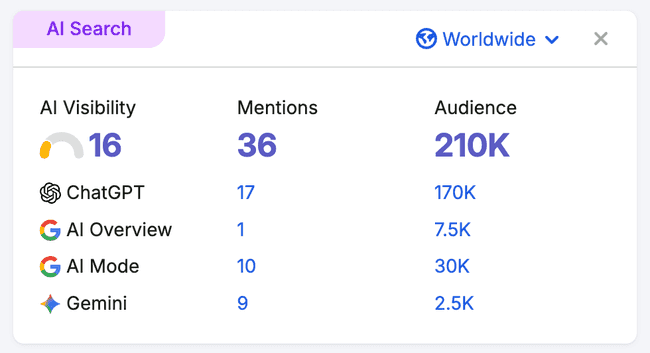
SEMrush data from Company A
Great, you think! Sure – it isn't a super high score, but we're starting out and we're already beating Company B.
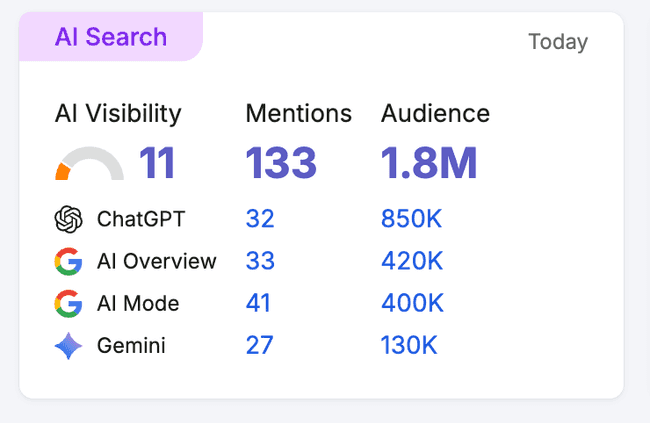
SEMrush data from Company B
But then you notice Company B has more mentions, and a higher audience figure.
Wait, what?
How can that be? How can you have higher AI visibility, but much lower mentions and audience?
Mentions
Mentions are like billboards. It's the AEO/GEO of equivalent of having X billboards around the country.
Mentions count the number of unique AI-generated answers where your brand appeared.
It doesn't mean that 30 people saw those answers! (It's probably much more.)
Audience
Audience is like the number of people who probably saw your billboards. It's the AEO/GEO of equivalent of 10,000 people seeing each of your billboards, on average.
Note: Nobody has reliable AI search volume yet (if they ever will)! LLM companies don't expose much data if at all, so this data is estimated by the vendors of the monitoring tools.
AI Visibility
AI Visibility is how good your billboards are. Are they big? Is the ad eyecatching and memorable compared to the two down the road? Are there other billboards crowding the space?
AI Visibility scores benchmark how visible we are inside AI answers, compared to everybody else.
Warning! It can be especially meaningless at the beginning of an AEO/GEO journey. I had a client recently who were delighted with their magically fantastic AI visibility score despite having virtually no traffic, which they took from SEMRush, because it was higher than their competitors. A tiny sneak at the data, though, showed they were getting virtually no views at all, but a couple of queries relating to the brand name where of course they were featured as the main source.
A high score can be deceiving – if you have a sparkling 50m billboard in an obscure village in the Scottish Highlands that hardly anyone sees, who cares? You'd rather have 500 30cm posters in London.
One more note!
First, a caveat: there isn't much standardisation in this space yet. Different AEO/GEO tools often use different names, methodologies and scoring systems for essentially similar concepts, so treat the numbers directionally.
Second, these metrics don't tell us anything about quality. To go back to our billboard example, if my billboard is selling cloud computing services and I buy a massive billboard in a rural farming community, I don't care a dot about my audience of 10,000, because I can pretty much guarantee nobody is buying my cloud software. More on this in a bit.
You'll need software...
Relax, I have no agenda. I've not tried every tool, and if you need one, I would suggest searching from scratch as this space is moving super fast. But...
- Shoestring budget/getting started? Could look at Peec AI or Profound. Not used myself, heard decent things.
- All-in-one with SEO? I'll happily recommend long-standing market leader SEMrush. I like the rich, reliable data, and it's built on well-established SEO tooling.
- Bit more to spend/Next steps? I like AthenaHQ which is comparatively richly featured, highly usable, but potentially overkill depending on where you're at.
The features we need most at this stage are:
- Topic and prompt opportunities (prompt segmentation is underrated and fantastic!)
- Headline metrics
- Mentions and prompt tracking
- Competitor tracking
- Source and citation analysis
AI visibility metrics: how do we know if it's working?
Starting from zero (or low)
If we're early on and not being picked up by LLMs at all, I'm really far less concerned about the numbers, because we're in research mode.
We're trying to understand:
- where competitors are appearing
- which sources AI systems trust
- how AI systems describe the category
- where we're absent and why
What I'd look for:
-
Source Opportunities: Sources frequently cited in AI answers that mention your competitors but not your brand. Generate ideas about where to try and get talked about.
-
Topic Opportunities: Prompts where your competitors are visible, but your brand is not. If our competitor is appearing in "Best tools for remote engineering teams", and we never do, we can use that.
-
Citations: Mentions tell you whether AI systems are talking about your brand. Citations tell you what they're trusting enough to use as a source. This helps us understand what AI systems trust, whether our own domain is being cited, and where competitors have stronger authority.
Is this starting to work? The #1 metric I'd use at this stage is...
Mentions
We're trying to start appearing in the right conversations at all.
Scaling it up
Once we're getting traction, we're going to switch gears, and start to ask:
- are we appearing more often?
- are competitors overtaking us or vice versa?
- are we becoming a default recommendation?
- are we strengthening our position in commercially valuable prompts?
The #1 metric I'd use at this stage is...
Share of Voice across commercially valuable prompts: How often are we appearing in the conversations that influence buying decisions, relative to competitors?
Frankly, I don't care if a brand I'm working for has a 20,000 strong audience for the prompt "What is cloud computing?". I want us to be mentioned in the AI answer to the prompt “Best cloud monitoring platforms for SaaS companies”, because that's where deals are born.
At this stage, I'm looking at AI Visibility, Mentions and Audience for signals about my reach, and also the quality of that reach.
Some other signals that help us at this stage:
- Branded search growth: If we're being discovered through AI, I expect to see branded searches rise
- AI referral traffic: Head into GA4 and look for referrals coming from AI (Look for utm_source = "chatgpt.com", etc.)
- Citation prominence: What position does a citation of our domain typically appear in?
If I had 3 hours a month to look at my strategy, I'd use my software to...
- Check my headline metric
- Split prompts by intent
- Inspect the actual AI answers.
For example:
- weak topical coverage => likely content gap
- competitors dominating cited sources => likely authority gap
- appearing inconsistently => possible positioning or authority problem
- broad visibility but weak commercial prompts => weak recommendation strength
- very few citations => weak trust or source visibility
Adapting an SEO content strategy for AEO/GEO
1. Build authority
Google itself has said that AI search is still fundamentally built upon SEO fundamentals.
You can't fake authority. Search engines evaluate content using Experience, Expertise, Authority, and Trust (E-E-A-T), and LLMs do, too. Think: first-hand anecdotes, supported claims, original research and statistics.
I wrote a guide to E-E-A-T, if you want to learn about it.
2. Structure content in an LLM-friendly way
AI search uses something called query fan-out, which means it breaks questions down into related sub-questions on its way to its answer.
This is a great opportunity! It means you can own specific use cases and niches without needing the authority to lead the main category.
Structure matters, too. If you have someone who knows about SEO doing this, it'll be happening naturally – but for AEO/GEO, be even more deliberate. Think logical heading sequences, scannable content, and short quotable definitions.
Target long-tail natural language queries, and give short, standalone answers. Add FAQs with direct answers to longer questions.
3. Place your bets on the right content formats
Prioritise content formats that have been shown to work, like...
- Best X for Y
- X alternatives
- X vs Y
- [Specific use case] software/tools
As part of your core SEO strategy, build your third-party proof – publishers, review sites, communities, Reddit and so forth. LLMs need to see external evidence.
What to take away...
Companies that win AI search are easy to understand, and easy to trust.
If you're starting from zero (or close to it), don't worry about doing things perfectly, because doing so isn't a good spend of time (think the 80/20 rule).
If you are doing SEO well, you're already doing a lot right. Being intentional about adapting that strategy, and adapting what you write, will give you the edge to find opportunities that drive results.

