


Mainstream marketing hyperbole can make us feel like we need to choose between "old-school" SEO and all the new search surfaces and tools.
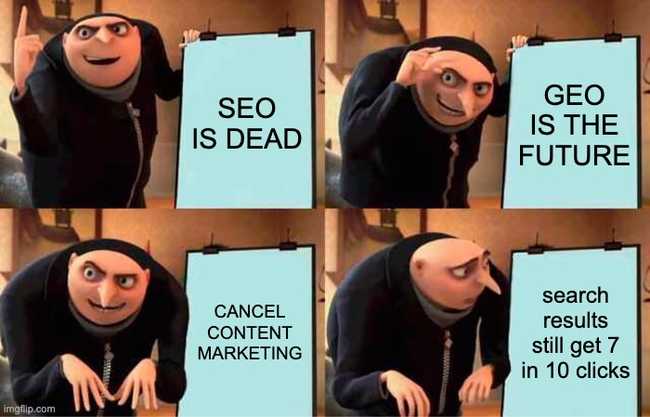
Everyone seems to think it's sexy to call old methods "dead" but, in this case, it's not grounded in reality. SEO still works. The first organic result alone on a SERP still wins 4 in 10 clicks.
But those of us working in growth will probably have seen E-E-A-T (or EEAT) emerge in the context of organic results rankings, and have originally understood it in this context. Now that the search surface is really fragmenting – giving rise to AEO (Answer Engine Optimisation) and GEO (Generative Engine Optimisation), we feel pressure to chase as many new and emerging search tools and features as we can.
Luckily, we don't have to choose between SEO, GEO and AEO.
We can do something that supports all of them: doubling down on E-E-A-T (Experience, Expertise, Authoritativeness, Trustworthiness).
What is E-E-A-T?
Let's start with a quick recap.
If you're after a full refresher, I like Search Engine Journal's Guide
E-E-A-T, which started life in Google’s Search Quality Rater Guidelines as E-A-T, stands for Experience, Expertise, Authoritativeness, Trustworthiness.
We can think of E-E-A-T like Google’s trust filter. Does our content look credible, rooted in real experience, and safe enough for them to put their name on?
Technically, it’s not a ranking factor. But E-E-A-T is the lens Google uses to interpret everything else: backlinks, schema, page experience, site reputation. For example, backlinks from a respected journal carry more weight than ten from a directory because they signal authority Google is comfortable with
You can pump out 1000 pieces of content. But if Google doesn't see us as experienced, expert, authoritative and trustworthy, we won't rank, get featured in voice results, or cited in AI-powered search experiences.
Anyone can throw together an article. So Google's after proof that you’ve lived it. Google wants to see the case study about the time your consulting helped BA squash their technical debt. The unique photos from your software engineering workshops. The podcast your founder did with Stephen Bartlett. These are the things AI cannot fake. Google's going to check your receipts too; are respected sites citing you? Are you in the press? What are your customers saying?
What others say about us matters as much as what we say about oourselves.
And now, that's true for AEO and GEO, as well as SEO.
Why do we care about being trusted?
If I had a penny for each time I've had to explain why we have to care about E-E-A-T to the board, I'd have about 3 pennies (not a lot, but it's weird it happened 3 times?)
My intuition is that it feels too abstract and unmeasurable for non-marketers to trust as a priority. With AI-driven search surfaces are cannibalising clicks, I imagine this is being asked more and more.
The first answer is of course that people are still clicking in droves, but around E-E-A-T specifically, the answer is that trust shapes the user journey long before they reach our site. Being cited is not wasted visibility. When our brand consistently shows up as credible, we’re positioning ourselves as the default choice:
- Visibility compounds. Search engines and AI assistants surface us more often, so acquisition costs less because we're earning attention organically.
- Conversion rates improve. By the time users do reach our site, we've already been framed as trustworthy, so there's less friction.
- Lifetime value grows. That stickiness that comes from our credibility increases retention and referrals.
Imagine we're SEMrush. A potential customer starts researching SEO tools. Google generates an AI overview, and our brand is called out as top for “in-depth analysis” and listed first among all-in-one platforms.
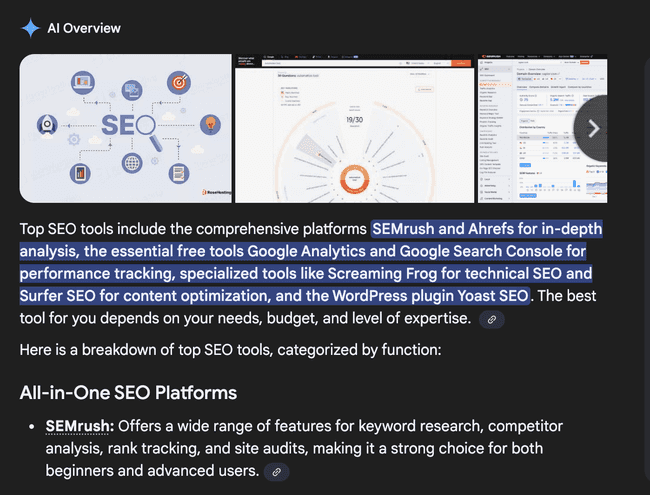
AI overview on Google's SERP for "best SEO tools"
“But they haven’t clicked yet!” The reality is, they don’t need to — the trust transfer has already happened. We (SEMrush) are now a frontrunner in the potential customer's mind. Every touchpoint from the AI snippet to the landing page is warmer because E-E-A-T shaped the journey.
Obviously, the funnel isn’t linear. Users bounce between problems and questions. E-E-A-T keeps us visible across that messy journey, so we don’t fall out of consideration.
If platforms trust us enough to cite us, our leads enter the funnel already primed, more likely to convert, and more likely to stay.
E-E-A-T both fills the funnel and compresses it. Prospects meet us with higher intent, move faster, and stick longer.
E-E-A-T Powers AEO and GEO
Answer Engine Optimisation (AEO) is about winning spots like snippets, People Also Ask, or voice results.
Generative Engine Optimisation (GEO) is about being selected as a cited source in AI-powered search experiences like Google’s SGE, or ChatGPT.
For a refresher on AEO, head here. Or for GEO, head here.
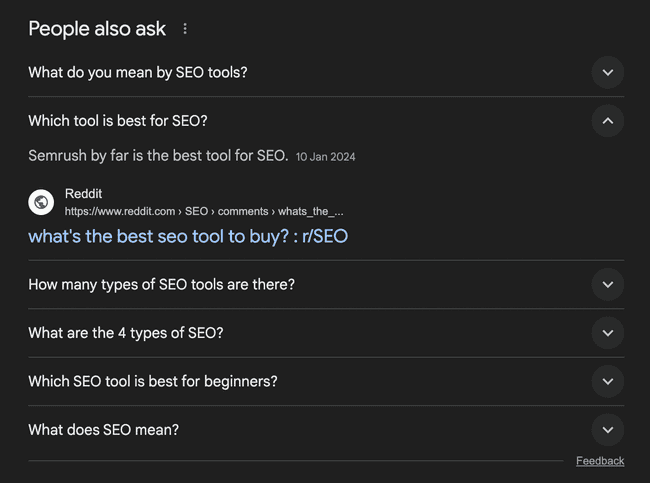
People Also Ask results for "What are SEO tools"
Both aim at scarce, high-trust sets of spaces. When Google surfaces our content – whether in a snippet or an AI overview – it’s staking its own credibility on you. E-E-A-T is our evidence to Google that you’re the safest pick.
The moment their search results show, we are increasingly likely to be considered the default option. They have some trust in us before even exploring our site. Every touchpoint from that AI summary to our landing page is warmer because E-E-A-T shaped the journey.
Think about how Google is moving with things like Perspectives, Shorts, video-first indexing. There are so many surfaces. Google needs us to show why it should be comfortable putting its weight behind us. E-E-A-T is the currency for this. If you’ve stacked up credibility across ecosystems – reviews, press, thought leadership, structured profiles – you’re harder to dislodge when multi-modal search really beds in.
This matters most where CAC is brutal: SaaS, finance, health. Anyone can pour money into clicks. Trust cannot be so easily bought. It must be earned.
E-E-A-T as trust architecture
I like to think about E-E-A-T as trust architecture.
Our content, from podcasts to research, form the scaffolding that makes us credible, and this trust architecture earns distribution without paying for clicks.
Our trust architecture is a fantastic growth lever – it’s able to deliver lower CAC, higher LTV, and more defensible market share. And it's powered by a growth loop (how it delivers it). The lever is the business impact; the loop is the mechanism that makes it compound.
How E-E-A-T works as a growth loop:
- We show evidence (case studies, reviews, thought leadership, all that good stuff).
- Platforms see us as a safe bet to surface and cite.
- We appear across more surfaces (snippets, Perspectives, AI summaries).
- Demand comes in warmer, so CAC drops and LTV rises.
- Those outcomes create more proof (reviews, PR, case studies) that feeds back into the loop, making us in turn more trusted.
The pushback I usually get sounds like this: “But if E-E-A-T can’t be measured, how can it be a growth lever?”
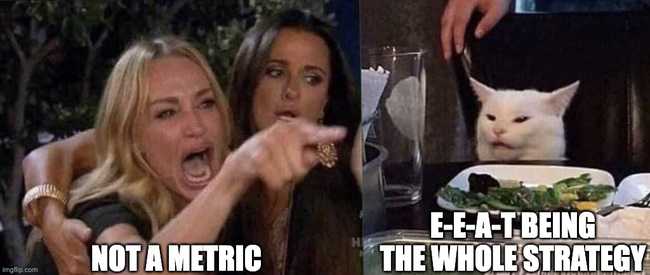
Explaining E-E-A-T in the boardroom
Absolutely, E-E-A-T isn’t a metric. You can’t slap it on a dashboard. We don’t measure “the framework”; we measure the routes inside it and the outcomes they drive:
- AEO/GEO surfaces: impressions and CTR from snippets, AI overviews, Perspectives. Benchmark against paid equivalents to show CAC efficiency.
- Trust signals: brand mentions, reviews, structured profiles, citations in authoritative outlets.
- Media & campaign impact: performance of specific podcasts, articles, webinars, or campaigns → referral volume, downstream conversions, assisted pipeline.
- Revenue outcomes: conversion rates, revenue, retention uplift from cohorts who first encountered us via high-trust surfaces.
It multiplies the effectiveness of everything else – a growth lever. And the reason it compounds is because it runs on a loop.
That's it.
E-E-A-T gives us the right lens to capitalise on the expertise and experiences we already have. When used as trust architecture, it scaffolds a strategy that gets us in front of potential customers — and trusted — before they even click.
That makes E-E-A-T a growth lever powered by a loop: proof creates visibility, visibility creates warmer demand, warmer demand creates more proof.
And in doing so, it gives us the best chance of showing up across every surface — SEO, AEO, GEO — without feeling like we have to choose.

